Wednesday, 15 January 2014

Unit 23: Multi-cam production blog


27th November 2013

Today our groups were formed for the multi-cam production of "Cinderella." The first group consists of Isaak Hest, Rose Ashworth and Ryan Bartle. The second group (Our group) has Shemar Chawla, Leah Sharp, Jordan Dent and Dale Whyte (Me). The first group has fewer people due to our class being uneven with 7 students, as a result of this one member from our group will be helping them in their production by operating one of their cameras (Still to be decided). Out job roles in the group have been decided. Shemar will be our Director, Jordan our Vision mixer, Leah the Sound Recordist and I will be the Lighting Director. As the lighting director in this production I will have very little say as to what the lighting will be as it is mainly up to the acting Director Sonya. So I will have to speak with Sonya to sort out the lighting in preparation for filming. 


11th December 2013

We went to the theatre to map out the camera shots and draw out a risk assessment, recce checklist and floor plan. We now have a better idea on how we are going to film the Cinderella project.

Risk assessment
Risks that we found were, trailing wires, staircase (In the dark it is impossible to see where you are going up the stairs), small possibility of falling lights. To overcome these risks we need to, tape the wires down, have some form of light source when moving around behind the seats and going up the stairs, making sure the lights are secure.

Location recce
In the location recce we wrote for things to take, camera, risk assessment form. "Talking to people;" confirm ownership, exchange details, explain intensions, passes are required, local events. No tansport is required. "Camera and lighting;" Secure place for kit, cables. "Sound;" Electrical hazard, background music. "Things for director;" photos.

17th December 2013

Rehersal
At 2:00 today we went to the rehersal for the Cinderella production and now have a better idea on how to set up the shoot. We now know who to focus on in the scene depending on where you are on camera. As the rehersal was going on I took a few photos so we could refer back to them if needed.


18th December 2013

We filmed the production. There were no problems with eny equipment apart from a tripod that wouldn't allow us to remove a plate. We are now ready for the capture and editing process.
 

9th January 2013

We began the capture process with the first four tapes which were both of the right and left side cameras for acts 1 and 2. I also capture a 5th tape accidentally one of the other groups tapes which unfortunately took an extra hour out of out edit time.
 

13th January 2013

We thought we had the final four tapes and in capturing we discovered that one of the tapes was one used in a different production. This tape was damaged and was unable to record on so we were panicing a little about if we might have used that tape or not.
 

14th January 2013

We found the actual final tape and captured it. This allowed us to set up the multi-cam edit and in a few hours it was complete. We would have captured but we had to leave for the day and didn't have the time.
 

15th January 2013

Now that it was all exported we were ready to burn it. I burned two copies one for he acting students tutor and one for ours. Now we are ready for the hand in.
 
Here is our title background picture;
 

Thursday, 9 January 2014

3 minute wonder production blog

November 1st 2013
The idea
My idea for my 3 minute wonder is to address Asperger syndrome, or "Asperger's." It will be a simple shoot of having someone with Asperger's say what it is like to have it, have an expert give a brief description on what it is, and have someone who has lived with someone who suffers from Asperger syndrome. It will require a lot of editing to cut it down to 3 minutes, but as long as all the interview subject give workable answers then it should be fine. The target audience are those who discover that someone they know (Family, friends) has Asperger's or they have it themselves and just to help them know what that means for whoever has it.

November 10th 2013
A small change
It has been made clear to me that I cannot use the expert in Asperger's and the person who has lived with someone with it as they will likely give too long answers and will not be able to use them at all. What I need to remember is that it is only 3 minutes and I cannot fit 3 interviews into that short a time. The interview with the person who has it will be more than enough.

November 11th 2013
Preparation
Filming will need to take place soon and I still need to make my proposal and pitch for the documentary. The proposal is close to completion and hopefully will be finished by tomorrow.

November 12th 2013
Ready to film
With the pitch/proposal now complete and knowing what I want to do for the documentary I feel that I can now go out and film. For the interview subject I will be giving a statement myself on my views on having Asperer syndrome. This does make it easier for me to film my 3 minute wonder as I know what I am looking for and can answer the main question. I won't be preparing any answers before I film the interview and will improvise an answer when it comes to filming.

November 21st 2013
Getting the equipment
To be perfectly honest, I was procrastinating getting the equipment and filming the documentary. But an opportunity arrised that has allowed me to finally film it. We went out to film another documentary about Paul Burgam, I was trusted with the equipment to take home so I can now film my 3 minute wonder. I will have that finished tomorrow.

November 22nd 2013
Finally filming
The previous night me and 3 others from my class filmed a section for another documentary as a group project separate from the 3 minute wonder. After that was filmed I was trusted with the equipment to take home until Monday. I took the opportunity of having the equipment to film my 3 minute wonder and also made a little short film (Just because I could). In filming the 3 minute wonder I had my the camera set up on the tripod and the clip mic attached to my shirt and answered common questions asked about having Asperger syndrome. This included "What triggers your abnormal behaviour?" "How friends/ family treated you any different since finding out about your Asperger's?" Etc. It took a few takes, I never realised how much I could talk to answer just one question. And after I was happy with what was filmed I watched it back a few seconds. As it turned out I forgot to turn on the microphone. I already had 9 minutes of footage (Which was now worthless) so I thought to myself to either re-record the interview with the microphone on this time, or add some non-diegetic dialogue in to try to sync up what I was saying. I came to the conclusion of just filming again as it was the easier choice. When the interview was finally over I was leaving the house with my equipment to get some cutaways of Redcar. I had planned to get a long panning shot from New Marske woods, shots of a moving train (Internal and external) A shot from the top of the beacon and the rest of the cutaways were filmed inside the house. When getting the external shot of the train I was surprised to see the station was filled with police men. I thought that with the amount of dogs and them looking through the bushes that they were searching for a large stash of drugs or something else illegal. As it turned out the royal train was pulling into Redcar and they were looking for anything that might cause harm to the royals. After getting 5-15 seconds of footage of the train one of the policemen came to me and asked me to leave. I explained what I was doing and he let me off but asked to not film any more on the platform. I knew something like this would happen so that was why I was stood in an area far away enough from them that it took them some time to get to me, and I could still get a good shot of the train. That night I was happy with what I got and received a message from another member of my class Isaak Hest. He needed the equipment so he could film the next day and asked if I could meet him tomorrow to give him it. I agreed and also took the opportunity of having the equipment that one night to make my short horror film.

November 25th 2013
Capturing
Came in ready to capture the footage. The 3 minute wonder footage was fine. The short horror was fine. The longer group documentary tape however was corrupted and all footage was lost. 2 out of 3 ain't bad, but it is still very annoying.

December 10th 2013

Beginning the edit
Admittedly it did take me a while to get around to the edit but that was only due to other assignments deadlines approaching. I knew the first 9 minutes of footage were useless due to the lack of sound, the rest was completely usable. It took a total of around 1 hour and a half to get it cut down and edited to completion of the offline edit. All that was needed then was to add in the cutaways and soundtrack. Unfortunately the day was at an end so I would have to come back the next day to finish it off.

December 16th 2013

Almost finished edit
I know I said I'd do it on the 11th but again other work took priority. Either way by the end of thew day I had the whole thing almost completed. All the cut aways and the voice over were shot and added to the video. All that was required was the soundtrack, which is my weakest point. It may take a while.

January 6th 2014

Finally finished
It took a while but after failing at creating my own soundtrack I decided to hunt for some royalty free music and after several searches and attempts at finding the perfect music I found one that worked very well with what was being said at what time. Here is the link; http://www.youtube.com/watch?v=0pSAzEN07Xk. I now feel confident burning it onto a disk.

January 9th 2014

Burned
The video is now burned and handed in.

Tuesday, 7 January 2014

Motion graphics Production blog

OCT 1st 2013
Initial idea: A crowd of people outside watching a large screen showing clips from different events and music videos from the 1970's. The shot zooms through the crowd to get a better view of the screen which shows more clips from that era. Finally the title of the programme shows on the screen. (No title so far)
Storyboard for 1st title sequence idea.
In this storyboard we can see that it will begin with a moving shot of an animated crowd watching a large screen as a type of concert. The screen features many different clips from the 70's showing things such as news stories, big TV/ film events, 70's music videos and bands, along with anything else that would concern that era. It will move through the crowd of people, going to the right until it is in the centre of the crowd facing the screen head on. It will finally zoom though the crowd and onto the screen alone so it is all that is in shot. The screen will then show the title of the programme "Hits of the 70's (Working title) and from there it will fade out and onto the presenter or presenters depending on how the script turns out.

70's font styles

As this will be centred around the 1970's it will have to feature as much content from the 70's as possible. This could be something as simple as font styles that were highly used and known throughout the era. Here are some examples;


From these images we can see that there is a large variety of different font styles that we do not use much today if at all. Any of these wold be service to use as a title and possible logo in the background.

13th Nov 2013

As for the actual presenting of the programme the room will be green screened as a 1970's style room as used by TV presenters in the 70's. The presented him or herself I am planning on being on being dressed in a 1970's style and open with something like "Hello and welcome to "Events of the era" (Working title) Today we will be looking at the 1970's which explains why I am dressed like this and why the room does also." In the 2-4 minutes of presenting various facts about the 70's will be either mentioned or shown in clips. This could be things like the death of Elvis. The birth of Disco. The premier of the show M*A*S*H*. Or any other event that was known in the 1970's. It will then end with either a highly known and popular music video from the 1970's (possibly "God save the queen" by the sex pistols as it is the number one on the 1970's music charts), or a montage of different clips from the 70's much like at the start when it is coming into the programme.

First draft for the presenters script.

19th Nov 2013

Mapping out all ideas for the production.


 Presenters look: The person who will be presenting this programme will be wearing 1 of 2 possible outfits. My first though is that he or she wear a 1970's style of clothing much like as seen in the pictures below;

This is to help them fit into the category of the 1970's and to possibly provide a little humour to the audience. Failing to obtain clothing like this then they will be wearing a more modern and simple style. This will most likely include a plain shirt, jeans or smart trousers, and sensible shoes, by this I mean no trainers.

1970's montage
In the title sequence and playing in the background there will be a montage of the 1970's. In this montage there will be randomised footage from music videos, news footage, old shows/Films and other content from the 70's. Music video clips that will be seen will be from popular artists who lived or died in the 70's such as Elvis or Michael Jackson. News related can show the 1972 Olympics terrorist attack along with the news article of Elvis passing.

20th November 2013

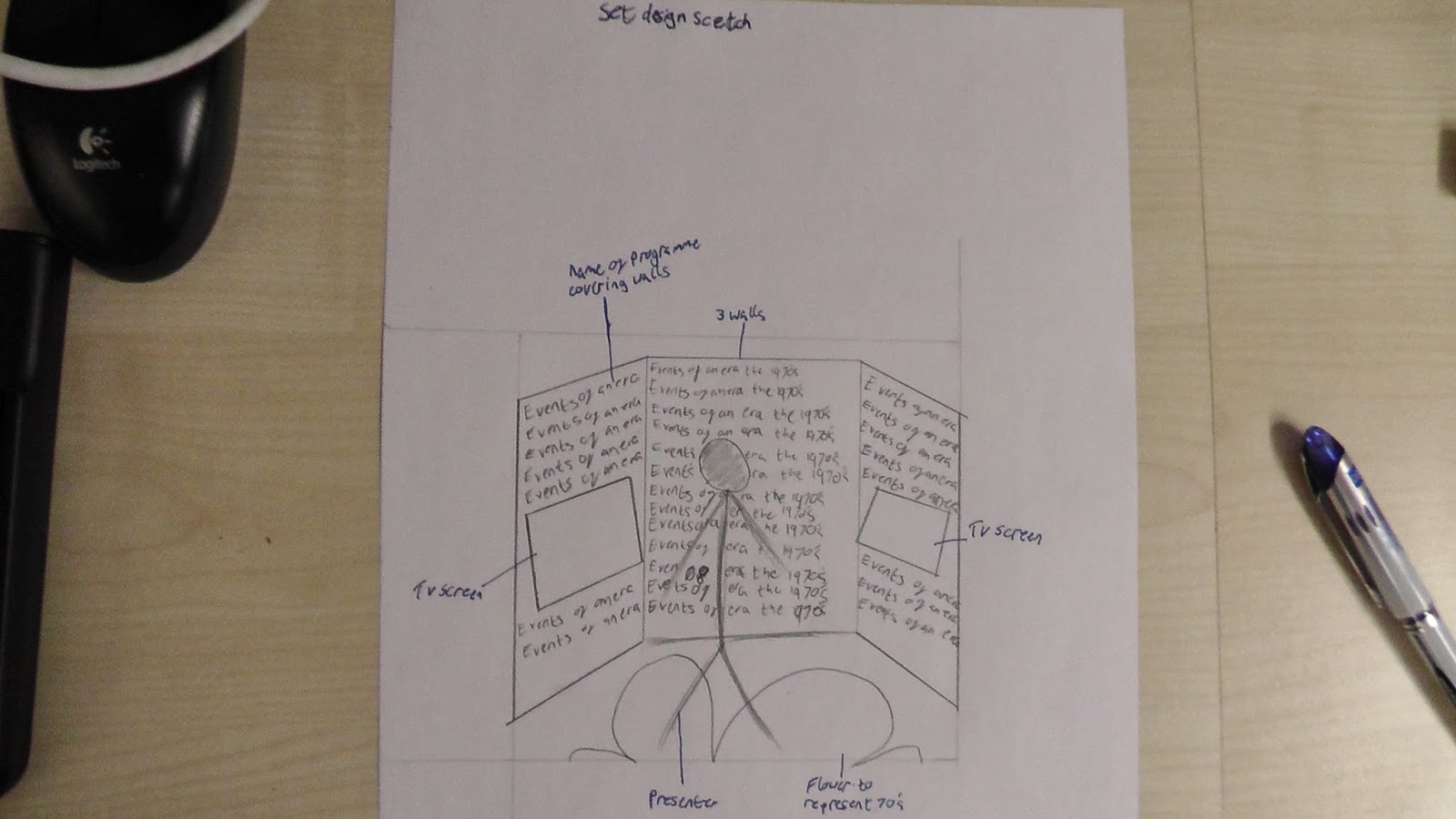
Set design sketch
As the deadline date is getting closer and closer I have began to think about what the set of the programme will look like. The presenter(s) will be stood in front of the middle wall where 2 other walls will be on either side, both with TV screen on showing footage of the topic which the presenter(s) is currently addressing. There will be a large flower on the ground to have a brief representation of the 70's. The walls will all be covered in a 1970's style wallpaper with "Events of an era the 1970's" written multiple times on it.

Working on the backdrop I have found the issue of setting the triple walls so they look accurate, and have yet to start on the floor. I have the design for the walls finished and only have to add all 3 into the same image. I looked up on Google how to set it out and came across this image that is a great example of what I am trying to do.

21st November 2013

Coming to improve my script and draw out my storyboard for filming I had the idea of working with the 2 minute time limit as a way on making my production longer. This consists of the intro having the presenter saying "Now I only have 2 minutes" and soon after when he or she is listing off the facts a 2 minute timer is counting down in the corner. There will also be someone off camera with a timer waiting to press the button so it is more accurate. Then I will include an outro which when but together with the intro makes it roughly 20-30 seconds longer which will give me a full 2 minutes of the information with a little bit of speaking with the audience added on.

Storyboard


Script second draft
With my new idea of being able to lengthen the production I had to rewrite the script to accommodate that. To do this I added more to the intro and outro, in the informative section when facts about the 70's is being listed then I have shortened some of the longer subjects to ensure that I won't go over the 2 minute limit for that section. As a result the script is not much different but it is an improvement.


2nd December 2013

My presenting actor is now decided as Rosa Graham. She is a first year acting student at Stockton Riverside and is more then egar to help out with this production. She will be supplying the 70's costume as she has assured me that she has 70's style clothes at home, so it saves me some money on purchasing some for her. She has received the script and will know it for the planned filming this Friday on the 6th.

(Rosa Graham)

6th December 2013

Today I filmed my presentation for the motion graphics and overall it went well. I was delayed with the fact that the room was opened 1 hour and a half later than first promised. It took 30-50 minutes to set up, film and clean away the equipment. Set up took about 10 minutes, clean up about 5 and the remainder was filming. It took so long due to my actress constantly making the same mistake of saying "1997" instead of "1977" but it wasn't too much of a problem. Footage captured was 11 minutes 21 seconds long, after the first few takes we decided to turn the camera off and run through it until we got it right. Rosa did really well and never complained on my points for improvement, and we ended up breaking into laughter whenever she said "1997" so it was a lot of fun to film. It was a bit more of a challenge to film the whole thing than I first thought. Another member of the class, Shemar Chawla, was supposed to meet me there at 10 to help film. We finished around 11-11:30 and he never came. This led me to operate the camera, set up the lights, run the teleprompter, direct Rosa, and I'm sure I'm forgetting something. This did provide me with more experience in all of these areas but I am concerned about the footage as I had to stay at the computer to run the Teleprompter and as a result could not see what the camera was capturing.

11th December 2013

Edit almost finished, just requiring to finish the set, balance out the screens, and add in a little soundtrack. While I was importing Rosa from the green scree onto the backdrop I accidental used the "Glass" tool in after effects and ended up spending the next half hour trying to work out what I did until I got help from an after effects expert in my class Jordan Dent. 

17th December 2013

Edit is now complete all I need is to burn it onto disk.

7th January 2014

Back in collge and able to burn onto disk. Checked through the finished project again to look for any problems I hadn't noticed and found several jump cuts that were seen in the monitors on the wall. Now that is fixed I am fully confident I can burn it onto my disk.


Now is burned and handed in.

Monday, 30 December 2013

Unit 8: Criteria 4: Understand developing technologies in television and film industries

In this blog I will be exploring how the advances in technology have changed the ways in which audiences view media and how the producers select their media content. I will be looking at Satellite, Cable, Analogue, digital, film-based, interactive and internet. 


The television and film industries have dramatically changed in the last few years because of the rapid development of new technologies. These changes in technology have enabled media companies and producers to gain an increase in audience which are of a range of different diversity. As a result, media contents have become broader, providing for a wider range of tastes and opinions and different ages to suit viewer’s life styles. (http://daviddadeyemi.blogspot.co.uk/2013/03/unit-8-understanding-tv-and-film_4.html)

Satellite
Satellite TV is a TV system that is transmitted through orbiting Satellites that send signals to each other, it amplifies the signal and transmits it back to the subscribers on earth who receive it through their antennas. ‘A satellite receiver is either in the form of an external set-top box or a satellite tuner module built into a TV set.’ Satellite TV transmits high-quality audio and picture digital data with the use of MPEG-2 or MPEG-4 compression. MPEG-4 is known for providing high-definition video streams to computers. (Wikipedia)

Through this viewers can watch hundreds of channels world wide and therefore gives a large range of programmes or films to choose from. However, the receiver and satellite dish can be expensive and not worth it; a separate receiver for each TV is needed, making it very expensive if like most people the consumer has more than one TV in their home. Satellites can also malfunction in bad weather giving the consumer bad transmission making the picture and sound lag or glitch. You can look at the people who use Sky in their home. As being one of those people I can vouch that when it get a little too rainy outside you cannot view anything on your television. Even with free view it can be a big issue when you're stuck in the house due to the weather.

Cable
Cable television is a system of distributing television programs to subscribers via radio frequency (RF) signals transmitted through coaxial cables or light pulses through fiber-optic cables. This contrasts with traditional broadcast television (terrestrial television) in which the television signal is transmitted over the air by radio waves and received by a television antenna attached to the television. FM radio programming, high-speed Internet,telephone service, and similar non-television services may also be provided through these cables. (Wikipedia)

Cable TV is stable in its services; there is only a problem with it if there’s a flaw in the whole system. This is not like the modern satellite television which goes off when there is storm. Combination of the cable TV with the internet or the phone can now be done, this way consumers have a single account to pay off both cable and their internet. However many cable companies are very confusing when it comes to how much their service will actually cost in the long run there are sometimes hidden cost which is a major disadvantage.                     

Virgin Media uses cable for their services and are best known for their fibre optic speed which makes them the faster service provider with broadband. 

Broadcasting on cable has been proven to be cheaper than satellite. This has lead to producers creating or moving more and more content to cable service as it is faster and cheaper 

Analogue
Analogue television in the United Kingdom includes terrestrialsatellite and cable services broadcasting using analogue television signals. As of 2013, Milton Keynes remains the only town in the country broadcasting in analogue, as the rest of the country have all switched off analogue signals and broadcast in digital only. (Web definition)

The whole of the UK and Northern Ireland no longer have the analogue system due to the digital switch over from 2008 – 2012, the analogue TV has been switched off and is impossible to get back if someone hasn't done the switch over they would be experiencing static on their television screen. However, analogue TV still exists in countries outside the UK in mostly developing countries for examples Nigeria, Namibia and Ghana.

Before the digital switch over I believe the numbers of producers where moderately low as there were only 5 television service providers. However, the producers that were around would have been very successful as there would be low competition for audiences.   

Digital
Digital television (DTV) is the transmission of audio and video by digitally processed and multiplexed signal, in contrast to the totally analog and channel separated signals used by analog television. It is an innovative service that represents a significant evolution in television technology since color television in the 1950s.[1] Many countries are replacing broadcast analog television with digital television and allowing other uses of the television radio spectrum. Several regions of the world are in different stages of adaptation and are implementing different broadcasting standards. There are four different widely used digital television terrestrial broadcasting standards (DTTB):
  • Advanced Television System Committee (ATSC) uses eight-level vestigial sideband (8VSB) for terrestrial broadcasting. This standard has been adopted in six countries, United States, Canada, Mexico, South Korea, Dominican Republic and Honduras.
  • Digital Video Broadcasting-Terrestrial (DVB-T) uses coded orthogonal frequency-division multiplexing (OFDM) modulation and supports hierarchical transmission. This standard has been adapted in Europe, Australia and New Zealand.
  • Terrestrial Integrated Services Digital Broadcasting (ISDB-T) is a system designed to provide good reception to fix receivers and also portable or mobile receivers. It utilizes OFDM and two-dimensional interleaving. It supports hierarchical transmission of up to three layers and uses MPEG-2 video and Advanced Audio Coding. This standard has been adopted in Japan, Philippines. ISDB-T International is an adaptation of this standard using H.264/MPEG-4 AVC that been adopted in most of South America and is also being embraced by Portuguese-speaking African countries.
  • Digital Terrestrial Multimedia Broadcasting (DTMB) adopts time-domain synchronous (TDS) OFDM technology with a pseudo-random signal frame to serve as the guard interval (GI) of the OFDM block and the training symbol. The DTMB standard has been adopted in the People's Republic of China, including Hong Kong and Macau. (Wikipedia)

The main focus of the digital switch over was to get the audience to modernise their technology. It also gives the audience in the UK an opportunity to explore a different range of channels to give them more varied range of entertainment to suit their lifestyles. It benefits the audience a lot as now they have more choice over what they watch and a much better quality of what they are watching. It is also beneficial for companies such as sky and virgin as they have got more subscribers because of the digital switch-over.

Digital TV has also giving producers a better chance of succeeding in the TV and film industry as they would gain a bigger audience base. However, this does increase competition between producers as they compete for their productions to be shown on the best channels and aired on the best time slot suited for their production. There has, most likely; been an increase in producers as there are many more channels on digital TV that need entertaining programs. 

Film based
As technology develops film based technology develops and becomes more advanced. 3D animation is one of these technologies, ‘in a nutshell, computer 3D animation refers to the work of creating moving pictures in a digital environment that is three-dimensional.’ (Animated TV) There is also another type of 3D animation called CGI, CGI (Computer-Generated Imagery) has become a popular form of animation of the years, beginning with films such as Pixar's Toy Story. Although CGI animation was used for creating 2D images, it was the use of 3D computer graphics in films and televisions which has raised the bar for the images the audience sees on screen. Due to the recent increase in 3D films there has even been films reformed into a 3D format such as films like Finding Nemo (2003) & Monsters Inc (2001) 

CGI animation is increasingly being used for producing high quality visual effects and realistic images. The accessibility to the CGI software tools, in the recent years, has enabled individual artists and small production units to come up with content without the use of actors, expensive set pieces, or props. 
There has also been a dramatic increase in IMAX cinemas around the world. IMAX cinemas (short for Image Maximum) are for from the average cinemas.

Interactive
Interactive television represents a continuum from low (TV on/off, volume, changing channels) to moderate interactivity (simple movies on demand without player controls) and high interactivity in which, for example, an audience member affects the program being watched. The most obvious example of this would be any kind of real-time voting on the screen, in which audience votes create decisions that are reflected in how the show continues. A return path to the program provider is not necessary to have an interactive program experience. Once a movie is downloaded for example, controls may all be local. The link was needed to download the program, but texts and software which can be executed locally at the set-top box or IRD (Integrated Receiver Decoder) may occur automatically, once the viewer enters the channel.

Interactive television (also known as ITV or iTV) is a form of media convergence, adding data services to traditional television technology. Throughout its history, these have included on-demand delivery of content, as well as new uses such as online shopping, banking, and so forth. Interactive TV is a concrete example of how new information technology can be integrated vertically (into established technologies and commercial structures) rather than laterally (creating new production opportunities outside of existing commercial structures, E.g. Internet. (Wikipedia) 

Internet
Internet television (or online television) is the digital distribution of television content via the Internet. Internet television is a general term that covers the delivery of television shows and other video content over the Internet by video streaming technology, typically by major traditional television broadcasters. It does not describe a technology used to deliver content.
Web television is a similar term often used to characterize short programs or videos created by a wide variety of companies and individuals, or Internet Protocol television (IPTV) - an emerging Internet technology standard for use by television broadcasters. Some Internet television is known as catch-up TV. (Wikipedia) 

There are many websites dedicated to showing this content and they are not stuck on one single genre. Take the most famous catchup web site Netflix for example. Unlike TV channels like for example comedy central who only show comedy, Netflix can show comedy along with Action, Drama, Horror, Mystery, ect. Other websites that unlike Netflix do the same for free are PutLocker, Cucirca, Viooz even YouTube. But by watching TV programmes on these web sites is considered illegal so maybe just stick with Netflix. 

The internet also has a lot to do with the media industry, it has changed the TV and film industry dramatically both for better and worse. Due to internet, audiences are now able to watch the favourite TV and film online when they want, whenever they want. This gives audiences chances to be able to control more of what they are viewing. However, because of this update in technology audiences are now able to download films illegally without paying. This has affected the producers in film industry most as they lose box office sales for their productions. It also affects film distribution companies like blockbuster as they lose consumers to the internet. Due to the internet the television and film industry has risen dramatically. Now because of the internet audiences are able to stream online, watch films and programs on-demand and pay to watch exclusive events. 

In conclusion. With all of these different methods of using technology in viewing and creating media productions that I have studied I now have a better understanding of each of these technological methods. I have looked at both Satellite and Cable television and explained their uses and methods along with their issues. I have explored analogue and digital TV. I now known about the digital switch over and why is was important. I have spoken about the internet and what dramatic effect it has had on the television and film industry and how they can interact with media content. I have also explored the development of standard television quality into new high definition quality and how people benefit from this. I believe that in a few years’ time technology would have advanced even further and would have a massive impact to the television and film industries. Soon cinemas will be showing in a virtual format.        

Wednesday, 27 November 2013

Unit 8: Understanding the Film and TV Industries task 2

Job roles in films
In this I will talk about the different types of jobs in the film industry, these being Creative, Management, and Technical jobs, and will talk about 3 different job titles for each of these areas. There are many roles in Television and Film and as of that I will not talk about all of them, which is why I have decided to talk about 9 and how they are used in productions.

Technical:
The Technical roles in Television and Film are the jobs that work with all of the electrical/technical equipment. For example there is the sound engineer who works with sound editing software and sound equipment in order to boost/fix the sound levels for the production. This can be something as simple as a soundtrack to having to record new sounds to lay over the previous, which is what is commonly known as Foley sound.

·         Digital Imaging Technician (DIT): The “DIT” is responsible for the coordination of the internal workings of the digital camera. Being under the direction of the Director of photography, the DIT will make adjustments to the multitude of variables available in the cameras in order to manipulate the image. Such work has been done in films like the Matrix. When in the Matrix the image had a hint of green so simulate what it would look like to be in a simulated world. It is more effective with the green impression as the computers back in the time it was made had a lot of that in their programming.

·         Gaffer: The Gaffer is the head of the electrical department, responsible for the design and execution of the lighting plan for a production. Sometimes the Gaffer is credited as “Chief Lighting Technician”. The Best Boy (Electrical) is the chief assistant to the Gaffer. Work seen by Gaffers in productions are sometimes un-noticed. But the subtle works of the make big differences in the production. It is their responsibility to properly organise the lighting and to make sure that it sets the mood of the production. Look at the film Donnie Darko. This physiological film used a wide range of lighting which varied between the scenes. But what is most notable is the lighting used when Donnie is having some type of illusion. The light focusses on that he is seeing, for example the auras that come out of people, but also doesn’t draw too much attention away from the rest of the scene. This is what made the film so brilliant because you can be completely focussed on what Donnie is seeing, but also you take in the whole of the room which is done through the combination of good camera work and lighting placement.

·         Foley sound team: Foley sound is the non-diegetic sound that is added after filming. For example a horse riding through a street would be difficult to capture sound for so a common method used is to have someone on the team get something that sounds like a horse running across stone, 2 halves of a coconut for example, and have them create that sound to lay over the horses gallop. Foley sound is used throughout most, if not all professional productions for all different kinds of sounds. In a film or programme set in medieval times, such as Game Of Thrones, when a sword is drawn that sound is not caught on camera. What a Foley team would do is get 2 thin metal objects and scrape one against the other in a fast motion causing it to make a ring, much like a sword being drawn. The possibilities for using Foley sound are endless. It is used for door sounds, ripping flesh, cars, etc. Without Foley Film and Television productions would be far less entertaining to watch.

Management:
Management roles are a lot less practical to technical and especially less practical than creative. Within the management roles you are overseeing or supervising or supervising areas of the production. There are many different types of management roles such as the Producer who oversees the director and other creative aspects of the production. Executive producer who manages the finance. Even lesser roles such as marketer who focus on the distribution of the finished product.

·         Producer: The producer initiates, coordinates, supervises, and controls matters such as raising funding, hiring key personnel, contracting and arranging for distributors. The producer is involved throughout all phases of the process from development to completion of a project. As the Producer you are responsible for making sure everything goes smoothly. To make sure that the talent isn’t acting up in any way that could hurt the production and to ultimately make sure that the production keeps up to date.

·         Location Manager: The location manager is responsible for finding and securing locations to be used for the production and coordinating the logistics, permits and costs involved. They are also the face of the production to the community. It is important for the location manager to ensure that those who are allowing you to film in their homes, business, etc, know how long they will be, and that they may need to return. There have been productions made where people who let a crew film in their home don’t know what time they are supposed to start, when they finish and what they do to their home. This means that they may be woken up early so they can film, will be kept out of their house upon returning and possibly find holes have been made in walls for the camera, lighting and other wires.

·         Production Accountant: Production accountants are responsible for managing finances and maintaining financial records during film production. They work closely with the Producer and the production office to manage the day-to-day accounting office functions, and report on the project’s financial progress against the budgets (cost reporting). They are responsible for knowing how much a scene will cost if it requires any big special effects or props. And to make sure that they do not go over budget.

Creative:
As creative is the most practical aspect of filmmaking a lot of people wish to work on when they first think about starting a career in the film business. Areas where creative is mainly seen is in the screenwriting, although not too practical, it plays a big role in the practical work. Direction is highly creative as the Director must think of creative ways to make the production more entertaining for the viewers in ways of simple, yet unusual shots and just telling the actors where to stand and how to perform the scene.

·         Director: The Director is in charge of the creative part of the production. This means they control the content and flow of the plot, direct the actors, select what is to be shown on camera, use of lighting, and the timing and content of the films soundtrack. Directors work to find ways of making their production more interesting through their use of shots. Take the Director Gregory Dark for example. He mainly directs music videos, but when he made the film See no Evil he used techniques he developed in music video production so when the video transitioned it added a very subtle, but great effect to the film by using the environment of the sets.
·         
       Set Designer: The set designer is the draftsman, often an architect, who realizes the structures or interior spaces called for by the production designer. They are in charge of the overall look of where they are filming. The Rob Zombie, Halloween remake is a good example in one of the early scenes. When they first got permission to film in what was used as the Myres house they found that the owner was a very messy person, as a result the house was disgusting. They had to clean up the whole of the living room, kitchen and bedrooms so it would look like a home. When Michael Myres was a kid he lived in a broken home, the set had to resemble that. So they had to “un-clean” the house making for a lot of un-necessary work. If the set designer had been there from the start then it would have saved the group a lot of work.


·         Screenwriter: The screenwriter, or script writer, is responsible for researching the story, creating the narrative, writing the screenplay, and delivering it, in the required format, to the Producers. They are almost always freelancers who either pitch original ideas to Producers in the hope that they will be optioned or sold, or who are commissioned by a Producer to create a screenplay from a concept, true story, existing screen work or literary work, such as a novel or short story. They are very important to the production as without them, without a script, there is no film.